
Stereo Agfa Isolette
This superbly constructed stereo camera is the
dedicated and persistant work of George Blake from New Zealand. The starting
point for the construction of this camera is a pair of Agfa Isolette 6x6
cameras that date from the 1950's.
The approach taken by George in achieving his goal
is quite a bit different from the normal cut-and-paste techniques most often
used when creating a stereo camera from two mono cameras. In particular,
the finished camera now features:
- A completely new camera body, made from sheet
aluminium and various angle extrusions to form the corners and joins between
the sections of sheet.
- A new aluminium camera back that fits snugly
on to the new body.
- On opening the back of the camera, the two original
bodies of the Isolettes can be seen fixed and nestled inside the new aluminium
body. The opposing ends of each of the old bodies have of course been removed
so the film gate separation can be set at approximatley 65mm. The original
film winding and take-up system has been retained.
- The bellows of the old cameras have been removed
from the bodies, but left attached to the shutter mechanisms, which have
been left unmodified.
- A new mounting arrangement for the two bellows,
shutters and lenses has been made in the form of a sub-assembly that screws
to the front of the new body. The complete lens/shutter/bellows sub-assembly
can be removed easily from the new body. The bellows no longer contract,
as the shutter board is fixed in position permanently.
- As part of the shutter sub-assembly, a simple
sliding bar has been made to sychronously fire the two independant shutters.
Synchronisation can be adjusted by placing packers between the bar and
the original shutter levers, or by bending the bar if really necessary.
While this is not as good as a coupled-shutter system, the synchronisation
appears consistently better than 1/100'th of a second.
- The focussing, aperture, and shutter settings
are not coupled between left and right. The apertures may be stopped down
to f32.
- A top-plate from one of the original cameras
has been placed on top of the new body to provide a view-finder system,
and it also visually completes the design as a camera.
- A tripod connector is available, and also provision
for cable release of both shutters. Flash is currently derived from one
of the flash connectors on either shutter, although this is not a good
system as it is too sensitive to timing errors between shutters.
- All the aluminium work was hand finished by using
successively finer files and abrasives until smoothly finished.
The overall result is an object of beauty. All
credit is due to George Blake, now in his late 70's, for the excellent results
achieved.
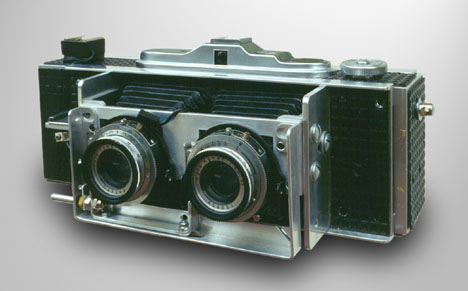
All photos taken with a Pentax SP1000,
fitted with a Kilfitt 40mm f3.5 macro lens, using Ektachrome Elite 100.
- Return
to Victorian 3D Society Inc. home page -
Feel free to send any questions or comments to The Society Secretary: maxhem@iprimus.com.au
The information contained in these Web pages may NOT be used or reproduced
for commercial purposes.
